You want to pay with crypto, not wait on exchange withdrawals, bank transfers, or manual cash-outs. That is where the virtual crypto card vs physical card decision gets real fast. Both let you turn stablecoin balances into everyday spending power, but the better option depends on how you live, where you spend, and how much control you want at the point of payment.
For some users, a virtual card is the fastest route from USDT or USDC to checkout. For others, a physical card still wins because the real world is not fully digital, and travel, ATM access, and in-store habits still matter. If you hold stablecoins for practical use, this is less about card theory and more about daily utility.
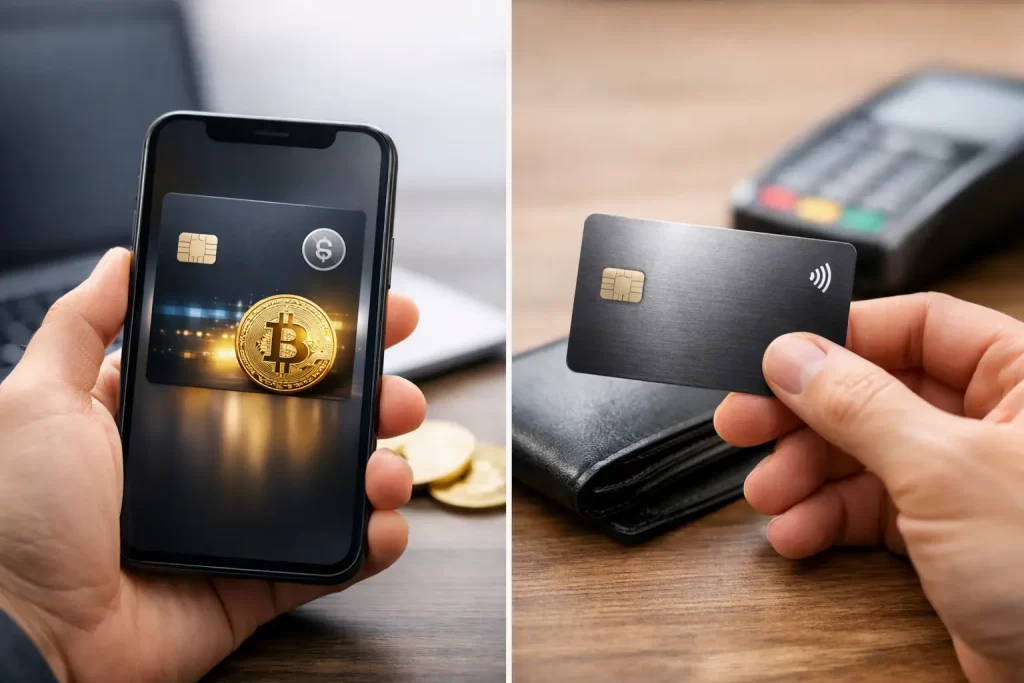
Table of Contents
Virtual crypto card vs physical card: the core difference
A virtual crypto card exists digitally. You get card details in an app or dashboard and can use them for online payments, subscriptions, and mobile wallet purchases if the provider supports Apple Pay or Google Pay. Setup is usually quick, which makes it attractive if your priority is instant access.
A physical crypto card gives you the same spend path with a tangible card in hand. You can tap it at stores, insert it at terminals that still require chip verification, and use it at ATMs where cash access matters. It is the more traditional form factor, but for many users it is still the more complete one.
Both card types typically work by converting supported crypto into fiat at the point of purchase. That means you are not asking merchants to accept crypto directly. You are using your stablecoin balance behind the scenes while paying in the format merchants already understand.
Where virtual cards win
The biggest advantage of a virtual crypto card is speed. If you need to start spending today, virtual is usually the shortest path. There is no shipping wait, no concern about losing a card in transit, and no need to carry one more item in your wallet.
That speed matters for remote workers, freelancers, and globally mobile users who move funds frequently and want immediate purchasing power. If you get paid in stablecoins and need to cover software, travel bookings, digital services, or online shopping, a virtual card feels direct. Fund the account, see your balance, spend.
Security can also be stronger in specific situations. A virtual card is harder to physically steal because there is no plastic to skim, clone, or leave behind at a café. Many users prefer generating or replacing virtual credentials faster than waiting for a new physical card. If your provider offers app-based controls, 2FA, and real-time transaction visibility, virtual can give you a tight grip on your spending environment.
Virtual cards also match the way many people already pay. If your card works with Apple Pay or Google Pay, you can use your phone at contactless terminals and avoid pulling out a wallet at all. That is a real advantage for users who live on mobile and want crypto spending to feel as normal as any other debit purchase.
Where physical cards still matter
A physical card covers the gaps digital-first users eventually run into. Not every merchant supports mobile wallets. Not every payment terminal behaves the same way. And not every country or travel scenario is friendly to app-only payments.
If you spend heavily in stores, travel often, or want cash access, the physical card is hard to replace. ATM withdrawals are the clearest example. A virtual card may support broad online and tap-to-pay use, but when you need local currency from an ATM, a physical card is often the tool that gets it done.
There is also a reliability factor. Phones die. Apps crash. Wallet provisioning can fail at the worst time. A physical card gives you a backup that does not depend on battery life or network conditions. For frequent travelers and digital nomads, that backup is not a small detail. It is part of staying functional across borders.
Some users also simply trust plastic more. That does not make them less crypto-native. It means they want a familiar payment object while still using crypto balances behind the scenes. If your goal is mass usability, the physical format lowers friction because people already know how to use it everywhere.
Security is not just virtual vs physical
Many comparisons stop at convenience, but serious users care about protection. The real security question is not whether a card is virtual or physical. It is how the platform handles risk, account access, wallet controls, and transaction monitoring.
A virtual card reduces some physical theft risks, but it can still be compromised through phishing, device takeover, or weak account protection. A physical card can be lost or skimmed, but strong app controls can limit the damage if the card can be frozen instantly.
That is why the stack behind the card matters more than the format alone. Risk screening on wallet addresses, multi-signature wallet controls, and multi-factor authentication are the kind of protections that make crypto spending feel usable at scale. They reduce exposure before funds ever reach the spend layer. A provider like KazePay leans into this model by treating security and compliance controls as part of the product, not a footnote.
For users spending stablecoins in the real world, that matters. Convenience gets attention, but trust keeps the card active.
Which card is better for travel?
If you travel internationally, the answer is often both.
A virtual card is excellent for booking flights, hotels, coworking spaces, software, and ride apps before you land. It gives you instant access and can plug into your phone for fast contactless spending. That is ideal when you are moving quickly and want to keep your funds liquid in stablecoins until the moment of purchase.
A physical card becomes important once you are on the ground. You may run into merchants that prefer chip and PIN, transit machines that behave unpredictably, or ATMs when cash is still necessary. In those moments, the physical card is less about preference and more about coverage.
For global users, the smartest setup is not choosing one forever. It is using each form where it is strongest.
Which card is better for online spending?
If most of your transactions happen online, the virtual card usually has the edge. It is faster to issue, easier to manage, and built for e-commerce behavior. You can use it for subscriptions, marketplaces, ad spend, travel bookings, and digital tools without waiting for a card to arrive.
There is also a practical privacy angle. Some users prefer separating online spending from their main physical wallet footprint. Using a dedicated virtual card for internet purchases can help contain risk and keep spending organized.
That said, a physical card can still support online payments if you have the card details. The difference is not whether it can work online. It is that virtual is designed for online-first behavior from day one.
The real decision comes down to your spending pattern
If you want instant setup, mostly shop online, and use your phone for contactless payments, virtual is probably the better first move. It gives you immediate access to your funds and turns stablecoins into usable spending power without extra steps.
If you want ATM withdrawals, in-store flexibility everywhere, and a dependable backup while traveling, physical is the stronger everyday companion. It covers more edge cases and gives you one less thing to worry about when mobile payments are not enough.
Most active stablecoin users eventually land on a combined view. Virtual handles speed. Physical handles reach. Together, they turn crypto from stored value into spendable money in more places, with fewer workarounds.
The best card is not the one with the most hype. It is the one that fits how you actually live, pay, and move. If your goal is fast access, global acceptance, and strong protection around every transaction, choose the format that removes friction today and keeps you covered tomorrow.
Choose the Card That Fits How You Spend
Whether you prefer virtual or physical, KazePay gives you a practical way to spend USDT or USDC without exchange withdrawals or bank delays. Use it online, in stores, or at ATMs — with the card format that fits your daily routine.
Fast access, real‑world utility, and control over how you pay.
👉 Sign up for KazePay and turn stablecoins into everyday spending power.