You can buy coffee in seconds with either product, but the money movement behind the tap is completely different. That is the real story in crypto cards versus prepaid cards. If you hold USDT or USDC and want real-world spending power without bank transfers, the gap matters even more because convenience, fees, and risk controls all show up at the moment you pay.
For most people, prepaid cards are familiar. You load dollars onto a card and spend until the balance runs out. Crypto cards look similar on the surface, but they are built for a different job. Instead of preloading only fiat, they let you fund spending from supported digital assets, often converting crypto into fiat in real time when you make a purchase.
That difference changes who each card is best for. If your income, savings, or daily balances already live in stablecoins, a crypto card can feel fast and practical. If you just want a simple spending bucket for gifts, budgeting, or travel cash, a prepaid card may still be the easier fit.
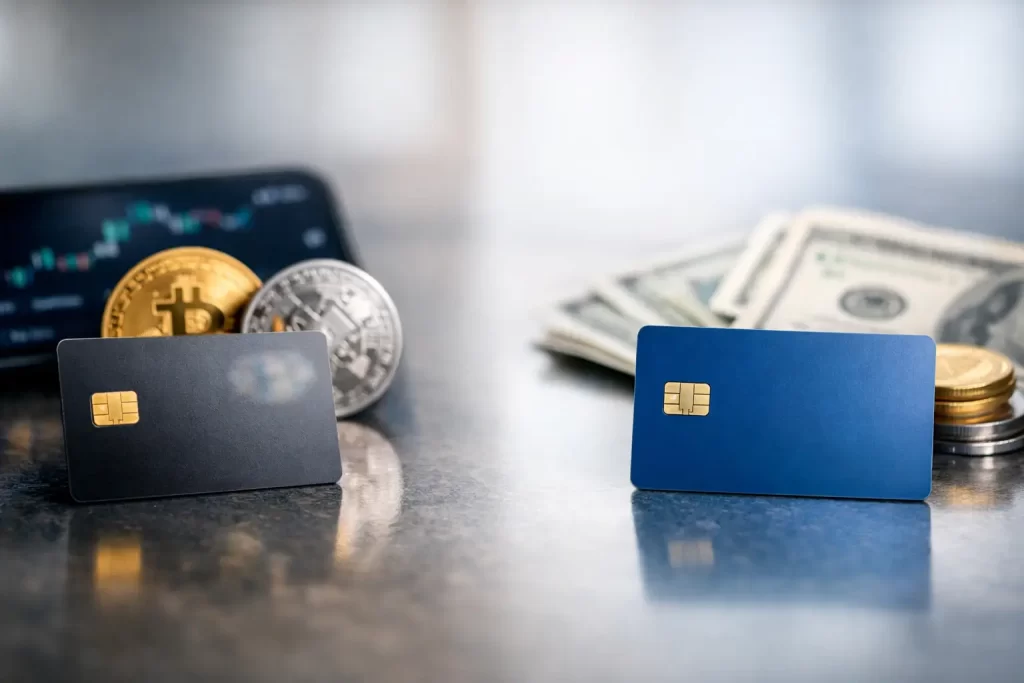
Table of Contents
Crypto cards versus prepaid cards: the core difference
A prepaid card is usually funded before you spend. You add money to the card from a bank account, paycheck, cash reload network, or another approved source. Once the balance is loaded, the card behaves a lot like a limited debit card. No reload means no spending.
A crypto card is designed to connect digital asset holdings to the card payment network. Depending on the provider, you may top up in advance or convert at the point of sale. In practical terms, that means your wallet balance can become usable purchasing power without a separate off-ramp step every time you want to buy something.
This is why the comparison is not just about card design. It is about where your money already sits. Prepaid cards work best when your funds begin in fiat. Crypto cards make more sense when your funds begin in crypto and you want to spend quickly in the same places traditional cards are accepted.
How funding and spending actually work
With prepaid cards, funding is straightforward. Add fiat, track the balance, and spend it. That simplicity is a big reason prepaid products remain popular. There is no exchange rate event for most domestic purchases, and the mental model is easy to grasp.
Crypto cards add an extra layer, but that layer is also the main value. If you are paid in stablecoins, store treasury in USDC, or move across borders often, using a card that converts supported crypto to fiat at checkout can remove a lot of friction. You do not have to manually send assets to an exchange, sell, withdraw to a bank, and wait for funds to settle before you can use them.
That said, not every crypto card works the same way. Some require pre-conversion into fiat balances. Others support near-instant conversion during the transaction. Some support only a short list of assets, and many focus on stablecoins because they are more practical for spending than volatile tokens.
For daily use, stablecoin support is often the real dividing line. Paying for groceries from a volatile asset can create tax and timing headaches. Paying from USDT or USDC is usually more predictable.
Fees are where the fine print starts to matter
A prepaid card can look cheap until reload fees, inactivity fees, monthly maintenance fees, ATM charges, and foreign transaction fees start stacking up. Many consumers have learned this the hard way. The product itself is simple, but the pricing can be anything but.
Crypto cards bring their own fee questions. You need to look at conversion spreads, card issuance fees, ATM fees, foreign exchange costs, and whether there are charges tied to funding, withdrawals, or asset conversion. If the provider is not clear on how conversion works, that is a problem.
The better approach is simple: follow the full path of your money. Ask what it costs to fund the card, what it costs to spend, what it costs to withdraw cash, and what happens when you use the card abroad. For crypto users, add one more question: how transparent is the conversion from digital asset to fiat at the moment of purchase?
A card that feels instant but hides a wide spread can quietly become expensive. A card with transparent fees and real-time tracking is usually easier to trust.
Security is not optional in either model
People often assume prepaid cards are safer because they feel more traditional. In some ways, they are lower risk than carrying cash. But prepaid cards can still be lost, skimmed, or drained if account protections are weak.
Crypto cards carry a different kind of scrutiny because the funding source is digital assets. That raises the bar for wallet security, access controls, and compliance screening. If a provider is serious, security should not be a marketing afterthought. It should be built into the flow through multi-factor authentication, strong account protections, and controls around where funds come from.
That last point matters more than many users realize. If a platform screens wallet addresses for sanctioned exposure, darknet activity, mixers, or other illicit signals, it is protecting the ecosystem and reducing the chance of compliance issues disrupting legitimate users later. The same goes for multi-signature wallet controls and other safeguards designed to reduce single-point failure.
For crypto holders, the question is not just whether the card works. It is whether the system behind the card is built to protect your balance while staying compliant enough to keep spending access reliable.
Acceptance and global use
Here prepaid cards and crypto cards can overlap a lot. If the card runs on a major payment network, acceptance at merchants may look very similar. You tap, insert, or use your digital wallet, and the merchant sees a normal card transaction.
The difference shows up before the payment reaches the merchant. With prepaid cards, your balance was usually loaded earlier in fiat. With crypto cards, supported crypto may be converted behind the scenes so the merchant still receives fiat through the normal card rails.
For travelers, freelancers, and remote workers, this can be a major advantage. If your working capital already sits in stablecoins, you can spend globally without adding the delay of manual off-ramping every time you move countries or need local purchasing power. Mobile wallet compatibility also matters here because phone-based payments are often faster and safer than carrying multiple physical cards.
Still, there are trade-offs. ATM access, regional restrictions, supported countries, and local compliance rules vary by issuer. A globally minded user should always check where the card can be issued, where it can be used, and how withdrawals are handled before treating it like a universal solution.
Who should choose a prepaid card
A prepaid card makes sense if you want controlled spending with minimal setup. It can be useful for travel budgeting, younger users learning money management, gifting, or separating a fixed spending pool from a primary bank account.
It also works well if you are not actively using crypto and do not want to think about wallet management, supported assets, or conversion mechanics. In that case, a standard prepaid product may feel more familiar and more than adequate.
The key limitation is obvious: prepaid cards do not solve crypto utility. If your money is already in digital assets, especially stablecoins, a prepaid card often adds an extra step because you still need to convert those funds into fiat before loading or using the card.
Who should choose a crypto card
If you are paid in stablecoins, move internationally, or keep part of your operating cash in USDT or USDC, a crypto card is built for your reality. It turns stored digital value into spendable purchasing power faster and with less friction than the old exchange-to-bank route.
This is especially true for people who want day-to-day usability, not speculation. A crypto card is not about staring at charts. It is about paying for flights, subscriptions, meals, and withdrawals when your balance starts in crypto.
The best crypto card experience also reduces trust friction. Quick sign-up helps, but strong protections matter just as much. A platform like KazePay leans into that balance by pairing instant crypto-to-fiat card utility with risk screening, multi-sig controls, and multi-factor protections, which is exactly what serious users should expect from a modern card stack.
The better question is not which card is better
The better question is which system matches how you actually hold and move money. If your financial life starts in dollars and stays in dollars, prepaid cards remain a practical option. If your financial life already runs on stablecoins and global mobility, crypto cards can remove steps, speed up access, and make spending feel immediate.
Neither product wins on hype alone. The right choice comes down to funding source, fee clarity, security depth, and where you need the card to work. Pick the card that fits your cash flow, not the one with the loudest promise.
The smartest payment tools do not ask you to change your life around them. They meet your money where it already is and make it usable with confidence.
Spend Stablecoins With Card Convenience
Crypto cards and prepaid cards may look similar, but stablecoin spending needs more. KazePay lets you fund everyday purchases from USDT or USDC with real‑time conversion, so you get the convenience of a card built for digital assets — without bank transfers or manual off‑ramps.
If your money already lives in stablecoins, KazePay helps turn it into practical spending power.
👉 Sign up for KazePay and use stablecoins with card convenience that fits real life.