You tap your card at a cafe in Lisbon, book a hotel in Mexico City, or pay for software from a US merchant online. The question is not whether the seller wants crypto. The real question behind merchant acceptance for stablecoin debit cards is whether that merchant accepts the card network and whether the crypto converts cleanly into fiat at checkout.
That distinction matters because it changes how people should think about spending USDT or USDC in daily life. A stablecoin debit card is not asking every coffee shop, airline, or online store to become a crypto merchant. It is using the existing card payments system, then handling conversion in the background so the merchant receives fiat through familiar rails.
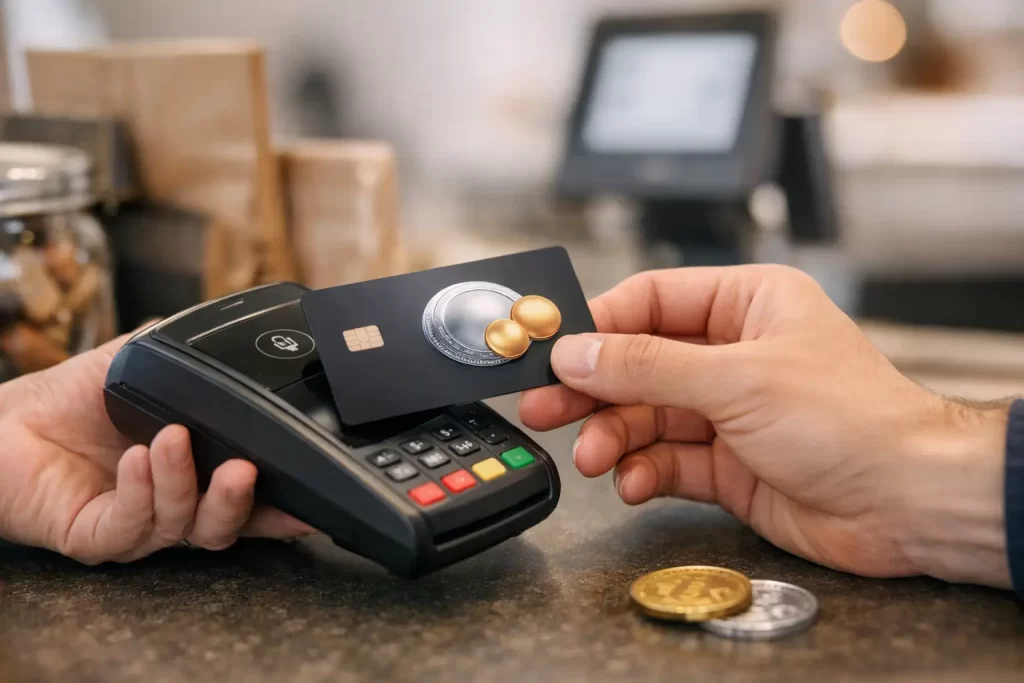
Table of Contents
How merchant acceptance for stablecoin debit cards actually works
For most users, the experience feels simple. You hold stablecoins, present a card, and complete a purchase anywhere traditional card payments are accepted. Behind the scenes, though, several layers need to work together in real time.
First, the merchant accepts a card payment through its normal payment processor. Second, the issuer or platform authorizes the transaction. Third, supported stablecoin balances are converted into fiat so settlement can happen in the currency the merchant expects. The merchant usually does not need a crypto wallet, stablecoin treasury policy, or any special accounting workflow.
That is why acceptance is often broader than people expect. In many cases, the merchant never interacts with crypto directly. From the seller’s side, it can look like a normal debit card transaction. From the cardholder’s side, it feels like spending digital dollars already sitting in a crypto balance.
This is the core value proposition. You keep the speed and flexibility of stablecoins, but you spend through infrastructure merchants already use.
What merchants care about more than crypto
Most merchants are not evaluating your wallet strategy. They care about authorization rates, fraud exposure, chargebacks, settlement reliability, and whether the customer can pay without friction.
If a stablecoin debit card performs like a standard payment card, acceptance improves because the merchant sees fewer surprises. If the transaction is declined, delayed, or flagged in a way that feels unusual, acceptance drops in practical terms even if the merchant technically takes cards.
That is why the strongest stablecoin card products focus less on crypto branding and more on payments execution. Instant conversion matters. Real-time authorization matters. Clear compliance controls matter. Strong wallet security matters because no one wants spending access tied to a weak custody model.
There is also a trust layer here. Merchants and payment partners want confidence that funds are not linked to sanctioned entities, mixers, darknet exposure, or other illicit risk. Security-forward platforms that screen wallet activity and apply strong controls are not adding bureaucracy for the sake of it. They are protecting the long-term viability of the card itself.
Where acceptance is strong and where it can get tricky
In day-to-day spending, merchant acceptance for stablecoin debit cards is usually strongest in places that already support mainstream debit card transactions. That includes restaurants, retail stores, travel bookings, ride-hailing apps, subscription payments, and many e-commerce checkouts.
Digital wallets can widen that reach even further. If a card works with Apple Pay or Google Pay, users can pay in environments where they may never even pull out a physical card. That matters for speed, but it also matters for merchant compatibility because mobile wallet acceptance is now standard across a huge range of businesses.
Where it gets trickier is with merchant category restrictions, issuer rules, local regulation, or edge-case transaction types. Some businesses place tighter controls on prepaid or debit products. Some merchants run extra verification for recurring billing, high-ticket travel, gambling, adult services, cash-equivalent transactions, or cross-border purchases. Hotel deposits, car rentals, and certain ATM scenarios may also behave differently because of temporary holds and authorization buffers.
So the honest answer is not that every card works perfectly everywhere all the time. The better answer is that acceptance is broad when the product is built on established card rails, but edge cases still exist because merchant rules and payment networks are not identical across categories and geographies.
Why instant conversion changes the acceptance story
Without instant conversion, stablecoin spending becomes clunky fast. Users would need to off-ramp manually, move funds to a bank, wait for settlement, and then spend. That is not real spending utility. That is extra admin.
With instant conversion at the point of purchase, the card behaves more like a practical payments tool than a crypto asset management workflow. That is what makes it useful for freelancers getting paid in USDC, travelers holding USDT, or remote workers moving between currencies and countries.
It also helps merchants indirectly. They do not have to take price volatility risk. They do not need a treasury function for digital assets. They receive fiat through the payment system they already trust.
For users, this creates a cleaner mental model. You are not asking, “Does this store accept stablecoins?” You are asking, “Does this store accept card payments?” That is a much easier question, and usually a much better one.
Security and compliance are not side features
Stablecoin cards only scale if payment partners, issuers, and users trust the flow of funds. That trust is built through controls, not slogans.
A security- and compliance-forward setup can include wallet address risk assessment, screening for sanctions exposure and illicit activity signals, multi-signature wallet controls, and multi-factor authentication. Those controls protect the platform, but they also protect acceptance itself. If a card program attracts compliance risk, its merchant reach can shrink quickly through restrictions, declining approval rates, or outright partner issues.
For cardholders, the benefit is just as direct. You want real-time access to your money, but you also want confidence that your funds are protected and your spending tool will keep working when you need it most. Security is part of usability. Compliance is part of continuity.
That is one reason products like KazePay position protection and screening as core infrastructure. In crypto payments, speed without control is fragile. Speed with strong controls is what turns a card into something you can actually rely on.
What users should look for before they assume global acceptance
Not all stablecoin debit cards are built the same. Two cards can both promise broad merchant reach, yet deliver very different real-world results.
Look at the conversion flow first. Is conversion automatic at the point of sale, or do you need to preload fiat? Then look at geographic coverage. “Global” can mean many things, and some products are stronger in certain countries than others. Mobile wallet support matters too, especially for users who travel often or prefer tap-to-pay.
You should also pay attention to fee clarity, ATM access, transaction visibility, and how the platform handles declines or holds. A card that works well for online shopping may still create friction for travel deposits or recurring subscriptions. That does not mean the product is weak. It means payment behavior depends on context.
For B2B partners considering a branded card launch, the same logic applies at the infrastructure level. Merchant acceptance is shaped by issuing relationships, compliance workflows, conversion mechanics, card operations, and risk management. A white-label partner is not just buying card design and distribution. It is buying reliability across the full transaction chain.
The bigger shift behind stablecoin card acceptance
The real breakthrough is not convincing every merchant to become a crypto business. It is making crypto balances useful inside the payment systems people already use every day.
That approach is more practical, more scalable, and frankly more likely to win. Consumers want instant access to their funds. Merchants want normal card payments with low friction. Stablecoin debit cards sit in the middle and translate one world into the other.
As this category matures, acceptance will keep improving where card rails, compliance, and conversion infrastructure are strongest. The winners will not be the loudest products. They will be the ones that make spending feel immediate, secure, and predictable across borders and merchant types.
If you hold stablecoins and want them to act like spendable money instead of parked balance, that is the standard to watch. The future of acceptance is not about asking merchants to change. It is about giving users a faster, safer way to pay wherever cards already work.
Spend Stablecoins Wherever Cards Are Accepted
Merchants don’t need to accept crypto for you to spend it. KazePay converts your USDT or USDC to fiat at checkout, so businesses receive a normal card payment through the networks they already use.
Coffee, hotels, software, travel — if the merchant accepts the card, your stablecoins can work there.
👉 Sign up for KazePay and use stablecoins through everyday card payments.