You do not want to wait three business days to spend money you already hold. That is the whole appeal of instant virtual crypto card setup: move from stablecoin balance to live card access fast enough to pay for a flight, renew a SaaS subscription, or add a card to your mobile wallet before checkout closes.
Speed matters, but speed without control is where payment products start to feel risky. If you use USDT or USDC for everyday liquidity, the best setup is not just instant. It is instant with clear identity checks, wallet screening, strong authentication, and a card you can actually use worldwide without forcing you through a manual off-ramp every time you want to buy something.
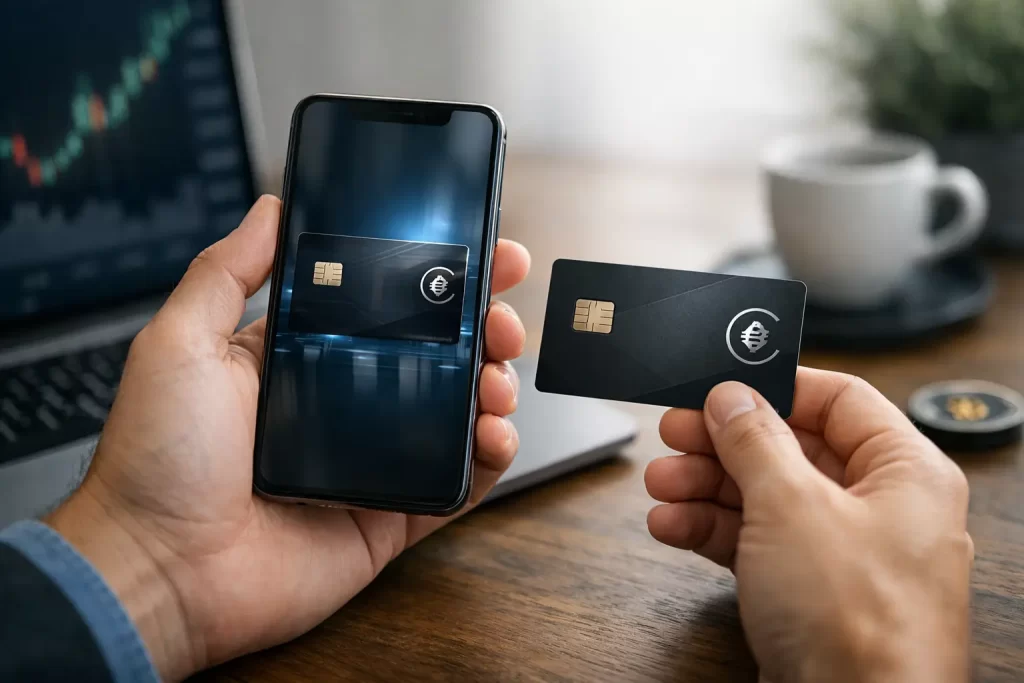
Table of Contents
What instant virtual crypto card setup should actually mean
A lot of products use the word instant loosely. Sometimes it means you can start an application instantly, not that you can actually get a funded virtual card ready for spending. For crypto users, that gap matters.
Real instant virtual crypto card setup means the account opening flow is short, the compliance review is built to move in real time where possible, and the card can be issued digitally as soon as the required checks are complete. From there, supported crypto balances should convert into fiat at the point of purchase, so the card works like a familiar debit experience instead of a complicated trading workflow.
That last part is what makes the product practical. You are not trying to become your own payments processor. You are trying to spend stablecoins online, in stores, and through mobile wallets with as little friction as possible.
Why stablecoin users care about speed
If you get paid in stablecoins, move funds between wallets regularly, or travel often, waiting is expensive in ways that do not show up as a line item. Missed bookings, delayed software payments, and awkward timing at checkout all create drag.
An instant setup cuts through that. It gives you a card number, expiration date, and security code quickly enough to start online purchases right away. If mobile wallet support is available, it also turns your phone into the payment surface, which is especially useful for remote workers, freelancers, and global travelers who do not want to carry every physical card they own.
Still, fast access only helps if the card is broadly accepted and the funding model is simple. A card tied to stablecoin spending works best when supported balances convert automatically at purchase. That removes the extra step of moving assets to an exchange, selling, withdrawing to a bank, and then waiting again.
The setup flow that saves time without cutting corners
The strongest card programs are built like payments products, not crypto experiments. That means onboarding is designed to be quick, but it also respects the reality that card issuance, fraud prevention, and compliance are not optional.
A good flow usually starts with registration and identity verification. From there, you add or connect the wallet or funding source that will support your spending. The platform reviews the wallet activity and risk profile, then issues the virtual card if everything clears. Once funded, the card can be used for online purchases immediately and, in many cases, added to Apple Pay or Google Pay for tap-to-pay convenience.
That process sounds simple because it should feel simple to the user. Behind the scenes, though, there is a lot happening. Wallet address risk assessment can screen for sanctions exposure, mixer interaction, darknet ties, and other illicit signals. Multi-signature controls reduce single points of failure. Multi-factor authentication adds another layer before someone can access or manage the account. Those details matter because they turn convenience into something you can trust.
Security is not a bonus feature in instant virtual crypto card setup
Crypto holders have learned this the hard way: the fastest product is not always the safest product. If a platform promises instant issuance but does not talk clearly about fraud controls, wallet protections, or compliance standards, that is not a feature. It is a gap.
Security-forward setup should include strong login protection, clear transaction visibility, and controls that let users act quickly if something looks off. Freezing a card, monitoring activity in real time, and confirming access with 2FA are the kinds of basics that serious spenders expect.
There is also a bigger trust issue at play. Crypto spending products sit at the intersection of digital assets and traditional payment rails. That means they need to satisfy both user expectations and regulatory realities. A platform that screens wallet risk and takes compliance seriously is not slowing you down for no reason. It is helping protect your funds, preserve network access, and support long-term usability.
Where people get tripped up
The biggest mistake is assuming all crypto cards work the same way. Some are prepaid in a way that requires manual loading. Some support only limited regions or merchants. Some advertise broad utility but break down when it comes to mobile wallet compatibility or ATM access.
The second mistake is focusing only on speed. Instant setup feels great on day one, but card performance matters more over time. You want transparent fees, broad acceptance, reliable conversion from supported stablecoins, and an interface that lets you track spending without guessing what happened between crypto balance and card transaction.
There is also an identity and compliance trade-off that users should be realistic about. If you want a card that works on established payment rails, some verification is part of the deal. The right provider minimizes friction, explains the process clearly, and gets you through setup fast. But no serious issuer can skip controls entirely and still offer a dependable product.
What to look for before you start
If you are comparing options, focus on whether the card is designed for actual daily spending. Ask a few practical questions. Can you fund spending with stablecoins like USDT or USDC? Does conversion happen at the point of purchase, or do you have to manually cash out first? Is the card virtual-first, so you can use it right away? Can you add it to Apple Pay or Google Pay? Is it accepted across a wide merchant footprint?
Then look at protection. Does the platform explain how it secures wallets and accounts? Are there risk-screening controls for wallet addresses? Is multi-factor authentication standard? Can you monitor transactions in real time and manage the card quickly if something changes?
These are not small details. They are the difference between a product that looks good in an ad and a product you trust for rent, travel, subscriptions, and everyday purchases.
Why global users benefit the most
For globally mobile users, instant card access is more than convenience. It is continuity. If your income, clients, and travel are spread across borders, you do not want your spending life split between crypto storage on one side and old-school banking delays on the other.
That is where a global-first card model stands out. When a card can be used across a broad set of countries and merchants, and when it supports familiar payment behavior through mobile wallets and card rails, stablecoins start acting more like working money and less like parked capital.
This is also why a strong platform can appeal beyond individual users. Fintech brands, wallets, and exchanges looking to launch their own card experience often need issuing infrastructure, risk controls, conversion logic, and compliance workflows already in place. Building that from scratch is slow and expensive. Using a white-label model can make sense if the underlying stack is built for secure, real-time spending from day one.
The standard to expect from a modern provider
A modern crypto card should make one promise clear: your money should be usable now, not eventually. That means quick sign-up, fast virtual issuance, real-time conversion from supported stablecoins, and card controls that keep pace with how people actually spend.
It should also make another promise just as clear: fast does not mean loose. The strongest experience pairs instant access with hard protections like wallet risk screening, multi-sig architecture, and 2FA. That combination is what turns a crypto card from a novelty into infrastructure.
KazePay is built around that standard. The goal is straightforward – help users spend crypto with ease while keeping the security and compliance foundation strong enough to support real-world use at scale.
If you are ready to stop treating stablecoins like funds you can only move between apps, start with a card setup that respects both speed and protection. The best experience feels immediate at checkout and dependable long after the first tap.
Get Instant Access Without Cutting Corners
Instant shouldn’t mean careless. KazePay gives you fast virtual card access backed by USDT or USDC, with clear verification, wallet screening, and strong security — so you can pay for flights, subscriptions, or online purchases right away.
Quick setup. Real controls. Global acceptance.
👉 Sign up for KazePay and start spending stablecoins instantly.