Cash still matters when you land in a new country at midnight, your landlord wants physical bills, or a local shop does not take cards. If you want to use crypto debit card at ATM, the process is usually straightforward – but only if you understand how conversion, fees, limits, and security work before you tap Withdraw.
A crypto debit card gives you a familiar way to spend digital assets in the real world. Instead of manually selling crypto, moving funds to a bank, and waiting, the card typically converts supported balances into fiat when you make a purchase or withdraw cash. For people who keep value in stablecoins and want fast access, that is the difference between holding crypto and actually using it.
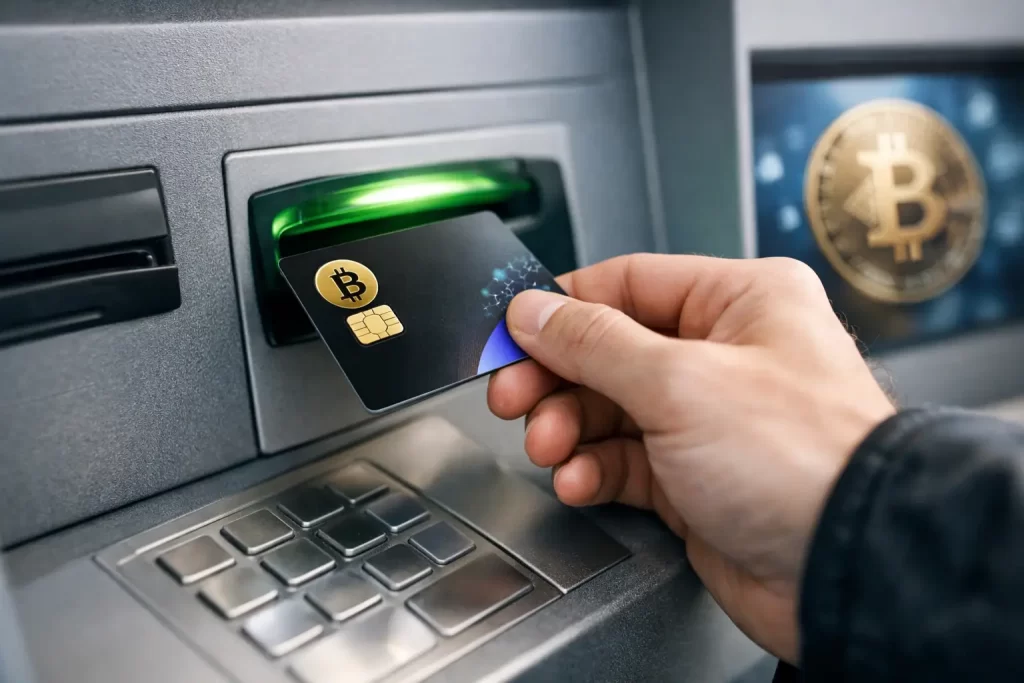
Table of Contents
What it means to use crypto debit card at ATM
When you use a crypto debit card at an ATM, you are not pulling crypto directly out of the machine. The ATM only understands local fiat currency. What happens in the background is that your card provider converts your available crypto balance into the fiat amount needed for the withdrawal, then processes the transaction through traditional card rails.
That sounds simple because, on the user side, it is simple. You insert or tap the card, enter your PIN, choose an amount, and collect cash. But the real experience depends on the card issuer’s rules, supported assets, exchange rate logic, daily limits, and security controls.
For most users, stablecoins make this much more predictable. If your spending balance is in USDT or USDC, you are not trying to time a volatile market just to get twenty bucks from an ATM. You know roughly what you have, what it converts to, and what the withdrawal should cost.
How ATM withdrawals with a crypto debit card usually work
The actual flow feels just like any other debit card withdrawal. You go to a compatible ATM, insert the card or use contactless if supported, enter your PIN, select checking or the prompted account type, and choose the withdrawal amount. If the transaction is approved, the ATM dispenses local currency.
Behind the scenes, your provider checks whether your card is active, whether you have enough available balance, whether the transaction fits your limits, and whether the ATM request passes fraud and compliance checks. Then the crypto-to-fiat conversion happens at the rate and fee structure defined by your provider.
This is why card quality matters more than people think. A good crypto card is not just about spending access. It is about instant conversion, real-time visibility, and strong controls that reduce failed withdrawals, suspicious activity, and ugly surprises on fees.
Before you use crypto debit card at ATM, check these 5 things
The biggest mistakes happen before the card ever touches the ATM. First, confirm your card supports cash withdrawals. Some virtual cards are built only for online spending and mobile wallets, while physical cards may include ATM access.
Second, check which crypto assets are eligible for spending. Some providers support a wide range of tokens, but many users prefer stablecoins because the value is clearer at the moment of withdrawal.
Third, look at your withdrawal limits. There may be a per-transaction cap, a daily cap, and a monthly cap. ATMs also set their own limits, so your card might allow more than the machine does.
Fourth, review the fees. There can be an issuer ATM fee, a foreign transaction fee, a network fee, and a fee charged by the ATM operator. On top of that, the exchange rate spread may affect the final amount you pay.
Fifth, verify your PIN and app access before you leave. If your card requires in-app approval, two-factor authentication, or security confirmation, you do not want to be troubleshooting account access while standing in front of a machine.
Fees can change the math fast
The idea of instant access is powerful, but ATM withdrawals are not always the cheapest way to use your crypto balance. Convenience has a price, and sometimes several prices layered together.
The card issuer may charge a flat withdrawal fee or a percentage. The ATM owner can charge a separate access fee. If you are abroad, the machine may offer dynamic currency conversion, which often looks helpful and is usually expensive. In many cases, choosing to be charged in the local currency is the better move because it avoids the ATM’s inflated conversion rate.
Small withdrawals are where fees hurt the most. Pulling out $20 can make sense in an emergency, but if total fees eat a meaningful percentage of that amount, it is inefficient. Larger planned withdrawals often work better, assuming they stay inside your comfort zone and security preferences.
Where ATM withdrawals make the most sense
Using a crypto debit card at an ATM is strongest in very practical moments. Travel is the obvious one. If you are moving between countries and already hold stablecoins, getting local cash without waiting on bank transfers can save time and reduce friction.
It also works well for freelancers and remote workers paid in crypto who want direct access to spending money. Instead of treating off-ramping like a separate project, they can use a card for purchases and take cash only when needed.
But there is a trade-off. If most of your life can be paid by card, mobile wallet, or bank transfer, frequent ATM use may not be the most cost-efficient path. The real value is flexibility – not turning every withdrawal into a routine habit.
Security matters more at ATMs than people realize
Crypto users are right to be security-conscious. ATM withdrawals combine digital account access with a physical device in a public place, which creates more points of risk than a normal app transfer.
Start with the machine itself. Use ATMs in bank branches, airports, hotels, or well-lit retail areas instead of isolated locations. Check for signs of tampering around the card slot and keypad. Cover your PIN entry. If the machine looks off, skip it.
Then think about account-level protection. Strong providers build security into the card stack with tools like multi-factor authentication, real-time transaction alerts, card freeze controls, and wallet protections behind the scenes. Security should not be an extra feature hidden in settings. It should be part of the product from day one.
Compliance matters too, even if users rarely talk about it. Risk screening on wallet activity and transaction patterns helps keep the ecosystem safer and lowers the chance of disruptions tied to illicit exposure. That is one reason platforms like KazePay position security controls and compliance checks as core infrastructure, not marketing filler.
Why withdrawals fail even when you have funds
A declined ATM transaction does not always mean your balance is too low. Sometimes the issue is simpler. Your card may not be activated for ATM use, your PIN may be wrong, or the machine may not support the network your card uses.
Other times, the problem is limits. You may have enough value overall, but not enough available balance after fees, holds, or conversion requirements. A requested $200 withdrawal can fail if the total processed amount needs to be slightly higher and your account does not cover the difference.
There are also compliance and fraud triggers. An unusual location, repeated attempts, or a high-risk transaction pattern can prompt temporary blocks. That can feel annoying in the moment, but it is often the same protective logic that helps stop unauthorized use.
Is a crypto debit card ATM withdrawal right for you?
It depends on how you use money. If you live in cards and mobile wallets, ATM access may be a backup feature you use occasionally. If you travel often, work across borders, or keep most of your liquid funds in stablecoins, ATM access can be a real quality-of-life upgrade.
The key is to think of it as spending infrastructure, not a cash-out trick. The best experience comes from a card built for everyday utility – fast conversion, broad acceptance, transparent costs, and security controls that are visible when you need them and working quietly when you do not.
If you plan ahead, know your fees, and use trusted machines, withdrawing cash from a crypto debit card can feel refreshingly normal. That is the point. The better the card experience, the less you have to think about the rails underneath it and the faster you get on with your day.
Use Stablecoins at ATMs Without the Guesswork
ATM access should be practical, not uncertain. KazePay converts your USDT or USDC into local cash at the point of withdrawal, with clear fees, limits, and security controls so you know what happens before you tap.
Simple cash access. Fewer surprises.
👉 Sign up for KazePay and withdraw cash from stablecoins with confidence.